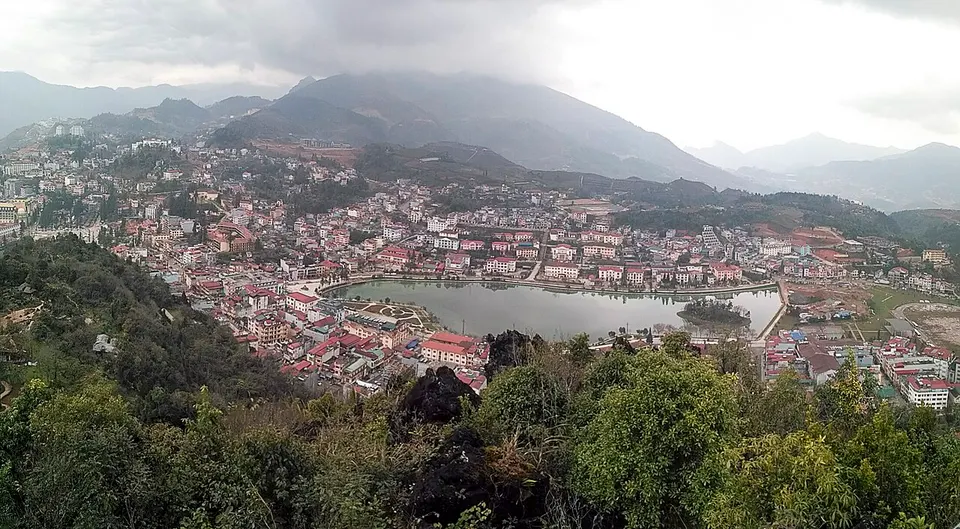
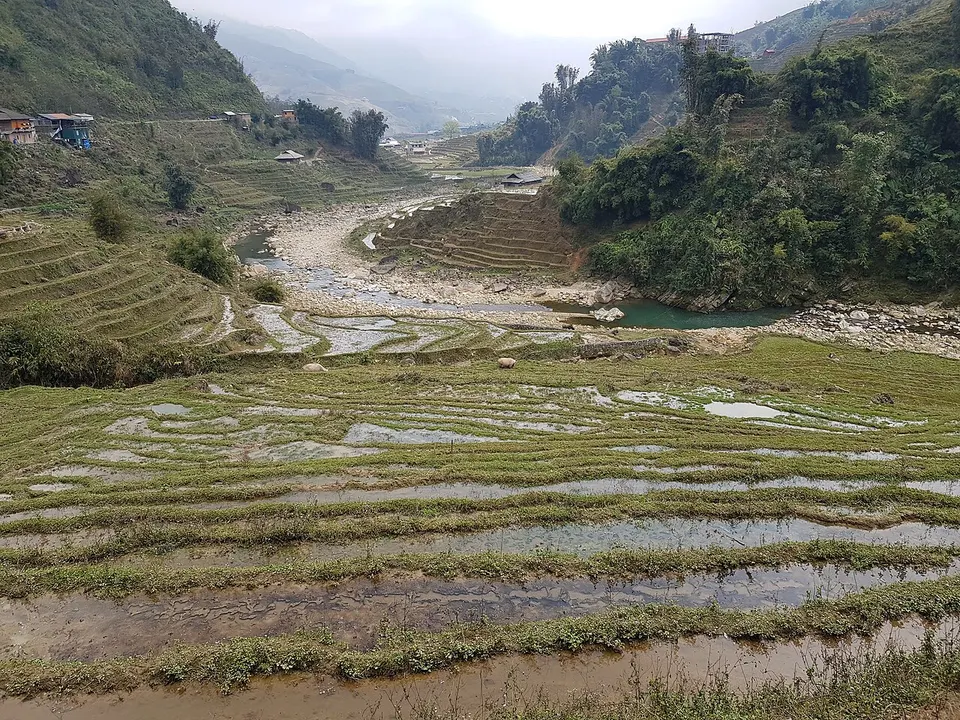
A mountain town at ≈1,500 m in northern Vietnam: a cable car up Fansipan (3,143 m), the highest peak in Indochina, the terraced rice fields of the Muong Hoa Valley, H'mong and Red Dao villages, and treks with homestay nights. Cool climate; in autumn (September) the rice terraces turn golden. From Hanoi it is ≈5.5–6 hours by limousine bus on the expressway, or by night train. From Ulaanbaatar you fly to Hanoi via Seoul, Hong Kong or Beijing. Mongolian citizens stay 30 days visa-free. June–August is very rainy and landslides hit the mountain roads.
🛂 Visa: Visa-free · 30 days✈ Flight: 9h☀ Best months: March, April, May, September
Orange — daytime average, blue — night, grey bars — rainfall, green — sea temperature. Best months: March, April, May, September, October, November.
Things to see (12)
📍🧸 for kids
Sun World Fansipan Legend — Fansipan cable car★ 4.6 (30,000)
NatureCable car return 850,000₫, children (1–1.4 m) 550,000₫, under 1 m free; cable car + Muong Hoa train + summit funicular 1,370,000₫ (children 1,070,000₫); +50,000₫ on Saturdays and holidaysCable car Mon–Thu 8:00–14:30, Fri 8:00–15:30, Sat 7:30–15:30, Sun 7:30–14:30 (last descent 16:00–17:00)
A world-record cable car takes you towards the 3,143 m summit of Fansipan, Indochina's highest peak, in ≈15–20 minutes. From the town centre the Muong Hoa train runs to the cable car station, and from the top station 600 steps or a funicular lead to the summit, with Buddhist temples and statues. It is about 10°C colder up there, so bring warm clothes for children; go early for less fog.
Muong Hoa Valley: Lao Chai–Ta Van trek and homestays
Travel guide
Like a well-travelled friend for a first-timer: before you go, landing, SIM, transport, money, food, safety, manners, apps, leaving — step by step.
🧳Before you goVietnam is visa-free for Mongolians; the main preparation is choosing the right season and packing mountain clothes and sturdy shoes.+
1
Visa: 30 days visa-free
Since 7 March 2024, Mongolian citizens with an ordinary passport can stay in Vietnam up to 30 days visa-free (not for work or paid activity). Your passport must be valid for at least 6 months, have blank pages, and you need a return ticket. For more than 30 days, get an e-visa on evisa.gov.vn (single entry $25, up to 90 days).
Tip: Only evisa.gov.vn is official; look-alike private sites charge extra.
The best months are March–May and September–November; in September the rice terraces turn golden. June–August brings downpours and landslides, and December–February is cold and foggy, with possible snow on Fansipan. In any season bring a warm jacket, a rain jacket and non-slip trekking shoes.
Tip: Over Tet (Lunar New Year) buses and hotels fill up far in advance.
Sapa has only basic medical care, so travel insurance that covers trekking and mountain roads is a must. Village fees, homestays and markets take cash, so get dong (₫) in Hanoi or from an ATM in Sapa town. Declare foreign currency over $5,000 at customs.
🛬Getting to SapaThe nearest international airport is Hanoi's Noi Bai (HAN); from there you head into the mountains by expressway or train.+
1
Limousine or sleeper bus
9–28 seat limousines run from Hanoi's Old Quarter or Noi Bai airport to Sapa in ≈5.5–6 hours for 320,000–450,000₫. Sleeper buses take ≈6–7 hours and cost 270,000–600,000₫; night buses reach Sapa at 4:30–5:00, so a daytime bus is better for families.
Trains leave Hanoi for Lao Cai at 21:35–22:00 and arrive at 5:30–6:10; a soft sleeper is ≈790,000₫ and a private cabin $45–65. From Lao Cai, Sapa is ≈35 km, ≈1 hour by minivan for 40,000–50,000₫.
Viettel, Vinaphone and Mobifone have counters in the Noi Bai arrivals hall: a tourist SIM with lots of data for 15–30 days costs ≈250,000–400,000₫. Viettel has the best coverage in the mountain villages, so choose it.
If your phone supports eSIM, install Airalo or a Viettel eSIM before the flight. Signal drops deep in the valleys, so download trek routes and maps for offline use.
🚇Getting around SapaThe town centre is walkable; for villages and waterfalls use taxis, motorbike taxis or a guided tour.+
1
Up Fansipan
From the town centre the Muong Hoa train runs to the cable car station, and the cable car climbs towards the summit. The cable car return is 850,000₫ (children 1–1.4 m 550,000₫, under 1 m free); a combo with the train and funicular is 1,370,000₫. Go early in the morning when there is less fog.
On routes such as the Muong Hoa Valley, Y Linh Ho and Ta Phin, hire a local H'mong or Dao guide and stay in a homestay — the money goes straight to the family. On rainy days trails are muddy with landslide risk, so don't go without a guide. Pay each village fee in cash at the gate.
Grab and Xanh SM work in town; for O Quy Ho Pass, Heaven's Gate and the waterfalls it is easiest to book a car through your hotel. Renting a motorbike on mountain roads requires a valid Vietnamese licence, and the steep, foggy roads are dangerous for inexperienced riders.
💳Money+
1
Dong and ATMs
Notes have many zeros, so don't mix up look-alikes such as 20,000₫ and 200,000₫ (both blue). Sapa town has Vietcombank, BIDV and Agribank ATMs, but villages have none, so carry cash on treks.
Cards work in hotels, at Sun World and in larger restaurants; village fees, homestays and markets are cash. Bargaining for crafts and embroidery is normal, but don't push too hard — it is a family's income. Tip your guide if you are happy with them.
🍜FoodMountain food: grills, hot pots and homestay meals.+
1
What to eat
Lau — hot pot with salmon (ca hoi) or black chicken; grilled skewers, corn and sweet potatoes at the night market; thang co — the traditional highland stew (made with offal, so not for everyone). Homestays serve family meals and rice wine.
Tip: Ask the price of salmon hot pot by weight and agree it in advance.
2
Water and hygiene
Don't drink tap water — use bottled or boiled water. Fake spirits have caused poisonings, so avoid alcohol of unknown origin. Carry enough water and light snacks on treks.
Police 113, fire 114, ambulance 115 — 24 hours. Operators usually speak only Vietnamese, so asking hotel staff, your guide or a Vietnamese speaker to call is faster.
During Typhoon Yagi in September 2024 many landslides struck Lao Cai province and trekking in Sapa was suspended. Highway 4D into Sapa has repeated landslides in the rainy season: on 4 May 2026 a huge boulder blocked it for ≈7 hours. In June–September follow weather warnings and keep a spare day in your plans.
Sapa's hospital offers only basic care; serious cases go to Lao Cai or Hanoi. Call your insurer's assistance line first. On the Fansipan summit the air is thin and cold, so people with heart or lung conditions and young children should walk slowly and dress warmly.
Giving village children sweets or money encourages begging and keeps them out of school. If you want to help, donate stationery to a school, buy crafts directly from families and hire local guides.
Ask before entering a H'mong or Dao home, and before photographing people — especially children and elders. A green branch hung at a door means a ritual is under way — don't enter. Don't walk through the fields; stay on the dykes.
3
Manners and the law
Raising your voice in an argument means losing face — stay calm. Cover shoulders and knees in temples and churches. Don't litter; carry rubbish out. Don't insult the state or Ho Chi Minh; drug penalties are extremely severe.
Use Google Maps to find trek routes and villages and download the valley maps offline. Google Translate's camera mode translates menus and signs on the spot.
From Sapa to Noi Bai is ≈5.5–6 hours by limousine, and in the rainy season landslides can close the road. Spending the night before an international flight in Hanoi is safest.
The visa-free period counts from your arrival day; overstaying means a fine at exit and may affect future entry. Spend leftover dong before changing it at the airport.
AI answer: double-check anything beyond our researched facts with an official source.
★ 4.7 (8,000)
NatureLao Chai–Ta Van area fee 75,000₫, children 50,000₫; guided day trek ≈$20–35, homestay ≈$10–25/nightDaily, in daylight
Sapa's best-known trek: ≈10–12 km through terraced rice fields to the Black H'mong village of Lao Chai and the Giay village of Ta Van. Spending a night with a H'mong or Dao family and eating home cooking is the essential Sapa experience. With children, walk a short section and take a car back; trails are muddy and slippery in the rainy season.
Culture150,000₫, children 80,000₫, under 1 m free (cash only)7:00–17:30
About 2 km downhill from the centre, a ≈3 km loop through a H'mong village: a waterfall, water mills, indigo dyeing and weaving demonstrations and traditional dance. It is quite touristy but the easiest village for families. The way back is uphill, so you can take a motorbike taxi.
Nature70,000₫, children (1–1.4 m) 30,000₫, under 1 m free6:00–18:00
The 'Dragon's Jaw' mountain right behind the town centre: orchid and flower gardens, a stone forest and ≈1–2 hours of steps and paths up to the Cloud Yard viewpoint. From the top you see Sapa town and the Fansipan range. A half day for families.
CityFreeSquare 24 hours; services usually morning and evening
A Gothic stone Catholic church built by the French in 1895 — the town's central square and meeting point. Nearby Sapa Lake has a walking path and cafés; in the evening the square hosts ethnic dance and music.
ShoppingFree; day trip from Sapa ≈$25–45Sunday about 6:00–14:00 (the buffalo and livestock market is on Saturday)
Northern Vietnam's largest and most colourful ethnic market: Flower H'mong women come in their finest dress to trade textiles, food and livestock. It is ≈100 km from Sapa, ≈2.5–3 hours by car, so leave early on Sunday.
O Quy Ho Pass and Heaven's Gate (Tram Ton)★ 4.6 (4,000)
NatureHeaven's Gate viewpoint ≈80,000–120,000₫, children 40,000₫Daily; best at sunset
One of Vietnam's longest mountain passes (≈2,000 m): seas of cloud over the Hoang Lien range and sunsets. The 'Heaven's Gate' platform on Tram Ton Pass looks over the valley. ≈15–17 km from town; foggy with cold winds, so bring a jacket.
A waterfall cascading ≈200 m beside the O Quy Ho Pass road; a short walk up steps to a bridge. Usually combined with Heaven's Gate and Love Waterfall. In the rainy season the flow is strong and the steps slippery.
A ≈100 m waterfall reached by a ≈1.5–2 km walk through bamboo and forest in Hoang Lien National Park, with a stream below. A quiet, cool forest path — a good short outing for families.
NatureSmall village fee (≈30,000–75,000₫, depending on the route); a guide is not required but recommendedDaily, in daylight
A Black H'mong village with few tourists, past Cat Cat on the western side of the Muong Hoa Valley: steep, demanding terrace paths. Often combined with a full-day trek to Lao Chai and Ta Van. Muddy days are slippery, so wear sturdy shoes.
Ta Phin village — Red Dao herbal bath★ 4.4 (2,000)
RelaxVillage fee 40,000₫, children 20,000₫; herbal bath in the village ≈100,000–200,000₫, from 300,000₫ at town spasDaily; baths usually 9:00–21:00
A Red Dao and H'mong village ≈15 km north-east of town: embroidery by Dao women in red headscarves, the ruins of an old monastery and rice fields. A hot wooden-tub bath of Dao medicinal herbs eases tired legs after a trek.
In the town centre in the evening: grilled skewers, whole roasted corn, sweet potatoes, hot dishes and ethnic handicrafts and embroidery. Bargain for prices; grilled food by the fire is welcome in the cold evenings.