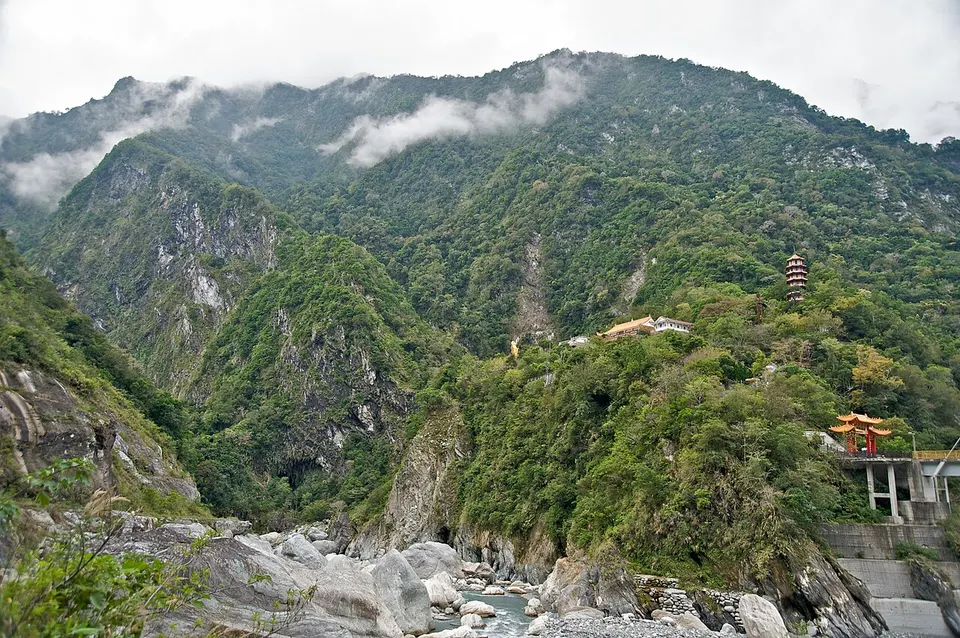
A quiet city on Taiwan's east coast: the Pacific, the marble walls of Taroko Gorge, the Qingshui Cliffs, Dongdamen Night Market and whale watching. Since the earthquake of 3 April 2024 most of Taroko's famous trails (Shakadang, Swallow Grotto/Yanzikou, Baiyang, Zhuilu Old Trail) remain closed as of October 2026, and the gorge road (Highway 8) only opens a few times a day — know this if Taroko is your reason to go. No direct flights from UB: land in Taipei (TPE) and take the train ~2–2.5 hours. Mongolian citizens need a visa.
🛂 Visa: Visa required✈ Flight: 9h☀ Best months: March, April, May, November
Orange — daytime average, blue — night, grey bars — rainfall, green — sea temperature. Best months: March, April, May, November.
Things to see (11)
📍🧸 for kids
Taroko: Visitor Center, Taroko Terrace and Dekalun trails
NatureFreeVisitor center ≈8:30–17:00; trails in daylight
As of October 2026 the most reliably open part of Taroko: the visitor center's exhibits on the earthquake and the gorge, and behind it the Taroko Terrace and boardwalk-stepped Dekalun trails for a 1–2 hour walk with views of the gorge mouth. Shakadang, Yanzikou (Swallow Grotto), Baiyang, the Zhuilu Old Trail and the Tunnel of Nine Turns are closed.
NatureFreeTianxiang–Taroko Entrance: 5 openings a day (6:30–8:00, 10:00–10:05, 12:00–13:00, 15:00–15:05, 17:00–18:00); closed nightly 18:30–6:30
Travel guide
Like a well-travelled friend for a first-timer: before you go, landing, SIM, transport, money, food, safety, manners, apps, leaving — step by step.
🧳Before you goMongolians need a visa for Taiwan and there is no eVisa. Most Taroko Gorge trails have been closed since the 2024 earthquake — set your expectations accordingly.+
1
Visitor visa — Taipei office in UB
Mongolian ordinary passport holders are on neither Taiwan's visa-exempt list nor its eVisa list. Apply in person for a visitor visa at the Taipei Trade and Economic Representative Office in Ulaanbaatar: BOCA fee $50 single entry, $100 multiple entry. Applications are taken on weekday mornings; the permitted stay is printed on the visa.
Tip: Prepare a passport valid for over 6 months, return ticket, hotel booking, bank statement and employment letter; confirm the document list by phone.
Paper arrival cards were abolished on 1 October 2025: fill in the Taiwan Arrival Card online, free, before you arrive. One person can submit the cards for the rest of the family.
According to the national park's official list, Shakadang, Yanzikou (Swallow Grotto), Baiyang, the Tunnel of Nine Turns, the Zhuilu Old Trail, the Eternal Spring Shrine trail and Buluowan are closed. Open: the visitor center, Taroko Terrace, Dekalun, Chongde and Tabido trails; Lushui and Dali-Datong partly. The Highway 8 gorge road to Tianxiang opens only 5 times a day and is closed at night. Mukumugi valley is also still closed to the public.
Tip: Re-check the park's 'Roads and Trails' page the day before — it changes after typhoons and quakes.
🛬Landing and getting to HualienTaoyuan (TPE) → Airport MRT → Taipei Main Station → TRA express train. Allow half a day.+
1
Airport MRT to Taipei Main Station
The Airport MRT express from under the terminals reaches Taipei Main Station in ~35–40 minutes. Tap an EasyCard or buy a token from the machine. The TRA station is in the same building.
Taipei–Hualien on the Puyuma, Taroko Express or Tze-Chiang trains takes ~2–2.5 hours and costs NT$583 (after the fare rise of 23 June 2025). Puyuma and Taroko Express are all-reserved and sell out at weekends and holidays — book on the TRA site or app from 28 days ahead. Without a seat, slow trains take over 3 hours.
Tip: If seats are gone, a standing ticket works on Tze-Chiang trains, but not on the Puyuma or Taroko Express.
Hualien Station is on the north-west edge of the city; take a taxi or bus to the centre and Dongdamen Night Market. Buses to Taroko leave from the bus station next door. Hualien Airport (HUN) has only a few domestic flights.
📶Phone and internet+
1
Tourist SIM at the airport
Chunghwa Telecom and Taiwan Mobile counters in the Taoyuan arrivals hall are open 24 hours. Chunghwa's unlimited 4G data: 5 days NT$300, 10 days NT$500. They may ask for your passport plus a second ID. Chunghwa has the most reliable signal deep in Taroko Gorge.
Tip: Bring a second ID — Taiwan asks for two documents for a SIM.
If your phone supports eSIM, buy a Taiwan plan from Airalo, Ubigi or similar before you fly and it works the moment you land. Signal can drop in the gorge and mountains, so download offline maps.
🚇Getting around HualienThe sights outside the city are far apart and public transport is thin — with children, hiring a car with driver or joining a day tour is easiest.+
1
To Taroko: bus or tour
Taiwan Tourist Shuttle 310 and Hualien Bus services run from Hualien Station to Taroko, but Highway 8 opens only a few times a day, so schedules deeper into the gorge change. Most visitors should either stick to the visitor center with the Taroko Terrace and Dekalun trails, or take a day tour with a driver who knows the road controls.
Driving a car or scooter in Taiwan requires an International Driving Permit; a Mongolian licence alone is not valid. Stay off mountain roads and the Suhua Highway in typhoons and heavy rain — rockfalls are common.
Hualien city is small — walk or take a taxi between the centre, the night market, Pine Garden and the creative park. A coastal cycle path leads to Qixingtan. An EasyCard pays for trains, buses and convenience stores.
Night markets, small eateries and guesthouses usually take cash only. Withdraw New Taiwan dollars (TWD) with a foreign card at ATMs inside 7-Eleven and at Bank of Taiwan or Chinatrust machines. ATMs are rare in the gorge and rural areas — leave the city with cash.
Spend NT$2,000 or more in one TRS-labelled shop on one day and you can claim the VAT back — show your passport in the shop for the form. Small refunds are paid on the spot in the shop, the rest at the airport.
🍜FoodHualien's food: night markets, Amis indigenous cooking, little steamed buns and mochi.+
1
Dongdamen Night Market
The main night market in the city centre: grilled sausages, seafood, Amis-style barbecue, bubble tea. It opens in the evening and runs until around midnight.
Tip: Go early — easier with children; sort your rubbish at the collection points.
Gongzheng's little steamed buns (公正包子), Hualien mochi (麻糬), wonton noodles, Amis wild greens and seafood. With children, convenience-store meals and breakfast shops are cheap and reliable.
Tip: No tipping in restaurants.
🛡️Safety and health+
1
Emergency numbers
Police 110, ambulance and fire 119 — free, 24 hours; 112 when the signal is poor. The 24-hour toll-free travel information line 0800-011-765 (English, Mandarin, Japanese, Korean).
Hualien is Taiwan's most earthquake-prone area. Quake alerts sound loudly on your phone — get under a table, protect your head and keep away from cliffs. Never enter closed trails, and wear a helmet where the park advises it. Typhoons can stop trains, flights and boats — follow the Central Weather Administration's warnings.
Beaches such as Qixingtan have strong currents and swimming is banned. In the city, Hualien Tzu Chi Hospital has 24-hour emergency care. Call your insurer's assistance line first.
Eating is banned on city metros and buses, but on long-distance TRA trains a bento is fine. Don't give away your reserved seat, and keep your voice down.
2
In indigenous communities
Many Truku and Amis people live here. Ask before photographing villages or ceremonies and don't wander onto private land. In temples, don't walk in front of worshippers.
3
In nature
Leave no rubbish in the national park, don't feed animals, and don't take stones or plants. Crossing barriers or tape on closed trails is fined and dangerous.
📱Useful apps+
1
Trains and roads
Book express-train seats on the TRA site or app. Google Maps shows train and bus times; the Highway Bureau's 168 site and app report road closures live.
Taiwan Arrival Card (TWAC) — before arrival. Taroko National Park — which trails are open. Central Weather Administration — typhoons, rain and earthquakes.
Hualien–Taipei by express train takes ~2–2.5 hours, then ~35–40 minutes on the Airport MRT to Taoyuan. Spend a night in Taipei before your flight or leave at least 6 hours' margin — typhoons and quakes can delay trains. Book your seat from 28 days ahead.
At the airport, before customs, show your passport, receipts and goods at the tax-refund kiosk or counter. Spend the EasyCard balance in a shop or keep it for your next trip.
AI answer: double-check anything beyond our researched facts with an official source.
The road between the marble walls is still under post-quake repair and opens in both directions only at set times. The Lushui Trail and Lushui–Wenshan Trail are partly open; Tianxiang's Xiangde Temple and the Tabido trail are open. Few places to stop, rockfall risk — better with a tour company or an experienced driver; check the schedule every day.
A 21 km wall of cliffs rising over 800 m straight from the Pacific — Taiwan's most dramatic coastal view. From the viewing platform at the north portal of Chongde Tunnel, the short Chongde Trail drops down to the surf. Officially 'partly open'; keep off the abandoned old road, where rockfalls are frequent.
A crescent of dark pebbles 15–20 minutes north of the city, with a blue sea and the Chongde mountains behind. Watch the sunrise, ride the cycle path, skip stones. Swimming is banned because of currents and a sudden drop — keep children away from the water's edge.
Hualien's main night market: grilled sausages, seafood, Amis-style barbecue, little steamed buns and bubble tea. In the city centre, walkable from most hotels.
CultureNT$60 (concession NT$50)9:00–18:00 (last entry 17:30); closed the 2nd Tuesday of each month (open daily in Jul–Aug)
A 1940s Japanese military building among old pines on a hill overlooking Hualien port and the sea. Exhibitions, a café and an air-raid tunnel; an hour is enough.
KidsAdult ≈NT$800–900, child ≈NT$700Apr–Oct several sailings daily (~2 hours); Nov–Mar groups only
Boats from Hualien port head out to the Kuroshio current to see dolphins and sometimes whales — operators report sighting rates above 90%. The sea can be rough, so take seasickness pills; trips are cancelled in typhoons.
KidsAdult NT$990, age 7–12 NT$690, age 3–6 NT$490, under 3 freeWeekdays 9:30–17:00, weekends 9:00–17:00 (ticket sales stop 2 hours before closing)
A theme park on a hill above the sea: sea lion and dolphin shows, an aquarium and children's rides. 30 minutes south of the city by car; a full day with children.
Hualien's largest mountain lake: a cycle path round the lake, pedal boats, SUP, and fireflies in April–June. 20–30 minutes from the city; pair it with Farglory or the East Rift Valley.
An 800 m plateau at Fuli in the East Rift Valley that turns orange with daylilies in August–September. About 2 hours south of the city by car — combine it with an East Rift Valley day (Ruisui, Yuli).