The Sherpa homeland of the Khumbu valley beneath Everest, the world's highest peak: walk from Lukla's mountain airstrip through Namche Bazaar, Tengboche Monastery and Dingboche to Everest Base Camp (5,364 m) and Kala Patthar in 12–14 days, sleeping in teahouses. This is not a city break — it is a trek for fit travellers ready for altitude sickness, cold and weather-cancelled flights. Fly to Kathmandu via a hub, then in peak seasons drive ~4–5 hours to Ramechhap (Manthali) for a 15–20-minute flight to Lukla. Mongolian citizens get a Nepal visa on arrival or online.
🛂 Visa: Visa on arrival · 30 days✈ Flight: 20h☀ Best months: March, April, May, October
#Everest#Himalaya#trekking#high altitude#Sherpa culture#adventure#visa on arrival
Orange — daytime average, blue — night, grey bars — rainfall, green — sea temperature. Best months: March, April, May, October, November.
Things to see (11)
🧸 for kids
Namche Bazaar★ 4.8 (6,000)
CultureFree (within the Sagarmatha National Park permit)Weekly market on Saturdays
The Sherpa 'capital', terraced into a mountain bowl at 3,440 m: teahouses, bakeries, gear shops and the last big village with ATMs. You reach it on day two from Lukla and spend an acclimatisation day here — Everest's first viewpoint is close by.
Sagarmatha National Park Visitor Centre and Sherpa Culture Museum★ 4.5 (1,500)
CultureVisitor centre free; Sherpa Culture Museum small fee
Travel guide
Like a well-travelled friend for a first-timer: before you go, landing, SIM, transport, money, food, safety, manners, apps, leaving — step by step.
🧳Before you goThe Everest Base Camp trek is a high-altitude trek that demands fitness and planning. Sort your visa, permits, guide and insurance in advance.+
1
Visa: get the 30-day one
Mongolian citizens need a Nepalese visa, issued on arrival at Kathmandu airport or through the Department of Immigration ETA/eVisa portal: multiple-entry tourist visa 15 days $30, 30 days $50, 90 days $125. With a 12–14-day trek plus Kathmandu days and spare days for flight cancellations, you need the 30-day visa. Your passport must be valid for more than 6 months.
Tip: If you get the visa on arrival, carry cash dollars (new, clean notes).
Two permits are compulsory: the Sagarmatha National Park fee of NPR 3,000 (in Kathmandu or at the Monjo gate) and the Khumbu Pasang Lhamu local fee of NPR 3,000 (Lukla or Monjo). No TIMS card is needed here. A 2023 government rule makes guides compulsory in national parks, but the Khumbu municipality does not apply it — that could change, so hire a licensed guide through a TAAN-registered agency.
Agencies won't take you without travel insurance covering helicopter rescue up to 6,000 m — ordinary policies don't. Train on stairs and hills for months beforehand and see your doctor. The best times are March–May and October–November; in the monsoon (June–September) flights are cancelled, and winter is bitterly cold.
🛬Getting to LuklaFrom Ulaanbaatar fly to Kathmandu; continue to Lukla by small plane, from Ramechhap in peak seasons.+
1
Peak season: via Ramechhap
From 25 Sep to 30 Nov 2026 (spring 15 Mar–15 May) all scheduled Lukla flights leave from Manthali (Ramechhap) airport, ~132 km from Kathmandu. You leave by car at 1–2 a.m. and drive ~4–5 hours; the flight takes 15–20 minutes. The foreigner fare is ~$210 one way; baggage is usually 15 kg (10+5).
Tip: Most agencies include the drive to Ramechhap in the package — ask to be sure.
Tenzing–Hillary Airport has a 527 m runway on an 11.7% slope and no go-around is possible; crashes killed 18 in 2008 and 3 in 2019. Cloud and wind routinely cancel flights for days. A shared helicopter costs ~$500–600 one way — a way around the backlog.
After landing, meet your guide and porter, buy the local permit and walk down to Phakding — the first day is short and easy. There are no roads above Lukla; everything is carried by people, yaks and mules.
📶Phone and internet+
1
Buy your SIM in Kathmandu
Get an Ncell or Nepal Telecom (NTC) SIM with your passport in Tribhuvan arrivals; Ncell tourist packs cost NPR 595 for 7 days, NPR 995 for 14 days and NPR 1,995 for 28 days. In the Khumbu 4G works reasonably up to Namche but drops out higher.
Most teahouses sell Everest Link Wi-Fi cards: ~$20 for 10 GB, ~$30 for 20 GB, valid 30 days. Charging costs extra — ~NPR 500 a day between Lukla and Namche, up to ~NPR 1,000 above Tengboche. There is no Wi-Fi at Base Camp; bring a power bank and sleep with batteries in your sleeping bag, as cold drains them fast.
🚇On the trailThere are no roads in the Khumbu — every distance is on foot. The standard route takes 12–14 days with two acclimatisation days.+
1
Standard route (12–14 days)
Lukla (2,846 m) → Phakding → Namche (3,440 m, acclimatisation day) → Tengboche (3,867 m) → Dingboche (4,410 m, acclimatisation day) → Lobuche → Gorak Shep and Base Camp (5,364 m) → Kala Patthar → back via Pheriche and Namche to Lukla. Above 3,000 m, raise your sleeping altitude by no more than 500 m a day and add a rest day for every 1,000 m.
A licensed guide costs ~$25–35 a day and a porter ~$18–25; you (or the agency) cover their food, lodging and insurance. A porter usually carries two trekkers' bags. When a yak train comes, always stand on the mountain side and wait — on the drop side you can be pushed off.
The currency is the Nepalese rupee (NPR). Lukla and Namche have a few ATMs, but they are often empty or broken, and cards are rarely accepted higher up. Withdraw enough cash in Kathmandu for the whole trek's food, Wi-Fi, charging, showers and tips, and keep it in a dry bag.
Everything costs more the higher you go: dal bhat is ~NPR 600 low down and ~NPR 1,800 at Gorak Shep; rooms ~$3–10, $10–30 in the upper villages; a hot shower ~$2–4 (usually none at Lobuche and Gorak Shep). Tipping your guide and porter at the end of the trek is customary.
🍜FoodYou sleep in teahouses and eat there too — ordering meals where you stay is the custom.+
1
What to eat
Dal bhat — rice, lentils and vegetables with free refills, the mountain 'fuel'; Sherpa shakpa stew, riki kur (potato pancakes), thukpa, momo (like Mongolian buuz) and yak cheese. Namche has bakeries and coffee shops. Meat keeps poorly at altitude, so vegetarian food is safer.
Tip: Drink lots of hot tea and soup — at altitude your body loses far more fluid than usual.
2
Water and your stomach
Don't drink tap or stream water untreated — carry purification tablets or a filter bottle, or buy boiled water; bottled water gets pricier with altitude and becomes litter. Avoid alcohol at altitude — it makes altitude sickness worse.
🛡️Safety and health+
1
Emergency numbers
Police 100, fire 101, ambulance 102, English-speaking Tourist Police 1144. Signal drops in the mountains, so helicopter rescue is arranged through your guide, teahouse or agency and your insurer's 24-hour line.
Headache, vomiting, poor sleep and fatigue are the first signs. Never go higher with symptoms; if you lose balance, are breathless at rest or become confused, descend at once and call for rescue. Acclimatisation days at Namche and Dingboche are a must; ask your doctor about acetazolamide (Diamox).
There is a small clinic in Lukla, the Hillary hospital at Khunde and the Himalayan Rescue Association post at Pheriche (spring and autumn); serious cases fly to Kathmandu. Helicopters can't come in bad weather — so descending early is the best treatment.
Always pass mani stones, mani walls and stupas on your left, walking clockwise — just as in Mongolia. Don't take or step on prayer flags or mani stones.
2
Monasteries and homes
At Tengboche and Khumjung, take your shoes off, cover shoulders and knees and sit quietly during prayers; ask before photographing, and a donation is customary. A teahouse kitchen is the family's space — don't enter uninvited.
3
Everyday manners
Greet with 'Namaste' or the Sherpa 'Tashi delek'. Give and receive food and money with the right hand. Carry your rubbish out — Sagarmatha National Park suffers badly from litter.
📱Useful apps+
1
Flights and transport
Check Lukla flights on the Tara Air and Summit Air sites (usually your agency books them). In Kathmandu, use Pathao or inDrive for taxis.
Download the Khumbu in Maps.me or Google Maps for offline use while in Kathmandu. Install Nepali in Google Translate for offline use. Ask your guide daily about weather and flights.
Flights out of Lukla are often cancelled for days by cloud and wind — leave 2–3 spare days before your international flight. In peak seasons you land at Ramechhap and drive ~4–5 hours to Kathmandu.
Nepalese rupees are almost impossible to exchange abroad — spend what's left or change it back to dollars. Overstaying by even one day means a fine on departure — if a cancelled flight strands you, extend your visa at the Department of Immigration in Kathmandu.
AI answer: double-check anything beyond our researched facts with an official source.
Daytime
On the hill above Namche: exhibits on the UNESCO-listed park's wildlife (snow leopard, Himalayan tahr, danphe pheasant), Sherpa life and the history of Everest climbing. On clear mornings you see Everest, Lhotse and Ama Dablam from here.
NatureFree to pass; tea or coffee for non-guests ≈US$5–10Daytime
A Japanese-built hotel from 1971 at 3,880 m whose terrace looks straight at Everest and Ama Dablam. Climb ~1.5–2 hours from Namche on your acclimatisation day, have tea and walk back. Helicopter tours land here too.
Khumjung — Hillary School and the yeti scalp★ 4.6 (1,200)
CultureDonation at the monastery to see the yeti scalpDaytime
The largest Sherpa village, at 3,790 m: the school built by Edmund Hillary's Himalayan Trust in 1961 and the 'yeti scalp' kept in the small monastery. Combine with Syangboche and Everest View as a one-day acclimatisation loop from Namche.
CultureFree (donation)Daytime; morning and afternoon prayers
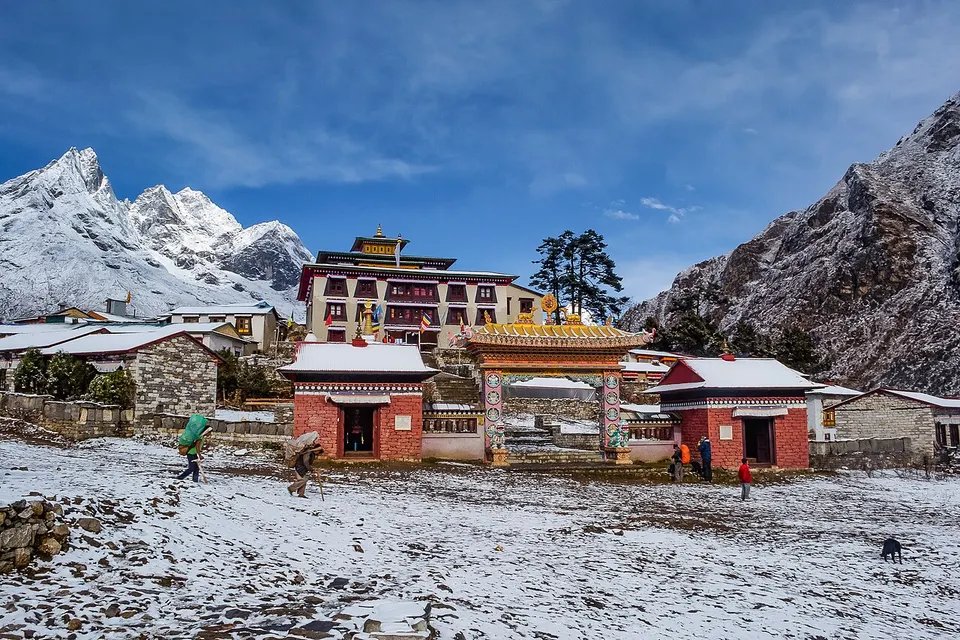
The Khumbu's largest Nyingma monastery at 3,867 m, with Everest and Ama Dablam behind it. You can sit in on the afternoon prayers; in October–November the Mani Rimdu festival brings masked cham dances. A place close to the heart of Mongolian Buddhists.
A village of stone-walled barley fields at 4,410 m — spend your second acclimatisation day here and climb Nangkartshang hill (~5,000 m) and back: 'climb high, sleep low'. Ama Dablam and the south face of Lhotse are right in front of you.
NatureFreeSunrise or sunset; 1.5–2 hours up from Gorak Shep
A black rocky ridge at ~5,550–5,645 m — Everest's summit can't be seen from Base Camp, so this is the most accessible close-up view of the peak. Leave Gorak Shep before dawn to watch Everest turn red at sunrise. The highest and hardest point of the trek.
At 5,364 m on the Khumbu Glacier: colourful tents in climbing season (April–May) and the Khumbu Icefall right in front. A photo at the stone marker is the trek's big moment — but you don't sleep here; walk back to Gorak Shep.
A quieter alternative to Base Camp: turquoise lakes beside the Ngozumpa, Nepal's largest glacier, the village of Gokyo at 4,750 m and, from 5,357 m Gokyo Ri, four eight-thousanders at once — Everest, Lhotse, Makalu and Cho Oyu. The Cho La pass links it to the Base Camp route.
Strung high over the Dudh Koshi river and draped in prayer flags, this bridge before the climb from Phakding and Monjo to Namche is one of the trek's most famous photo spots. Monjo has the Sagarmatha National Park gate and permit checkpoint.
Nature≈US$250–325 per personMornings from ~6:00, flight ~1 hour
For those without the time or fitness to trek, and for families: Buddha Air and others fly ~1 hour along the Himalaya from Kathmandu every morning and show you Everest up close; every passenger gets a window seat. Postponed on cloudy days.
For a quieter route, turn off from Namche to the Gokyo Lakes and Gokyo Ri, and if experienced, cross the Cho La pass to Base Camp. Short on time, you can fly back from Base Camp to Lukla or Kathmandu by helicopter — have your agency check price and weather.