Korea's fourth-largest city — cheaper and calmer than Seoul, known for its food and shopping. Seomun Market's night market, the Kim Gwang-seok mural street, E-World and 83 Tower, cable cars up Apsan and Palgongsan, a 350-year-old herbal medicine market and a day trip to Haeinsa Temple (UNESCO). In summer it is Korea's hottest city ('Daefrica'); spring and autumn are best. A direct Ulaanbaatar–Daegu flight runs in some summers; otherwise arrive via Busan or Incheon and take the KTX. Mongolian citizens need a visa.
🛂 Visa: Visa required · 90 days✈ Flight: 3.6h☀ Best months: April, May, October, November
Orange — daytime average, blue — night, grey bars — rainfall, green — sea temperature. Best months: April, May, October, November.
Things to see (12)
🧸 for kids
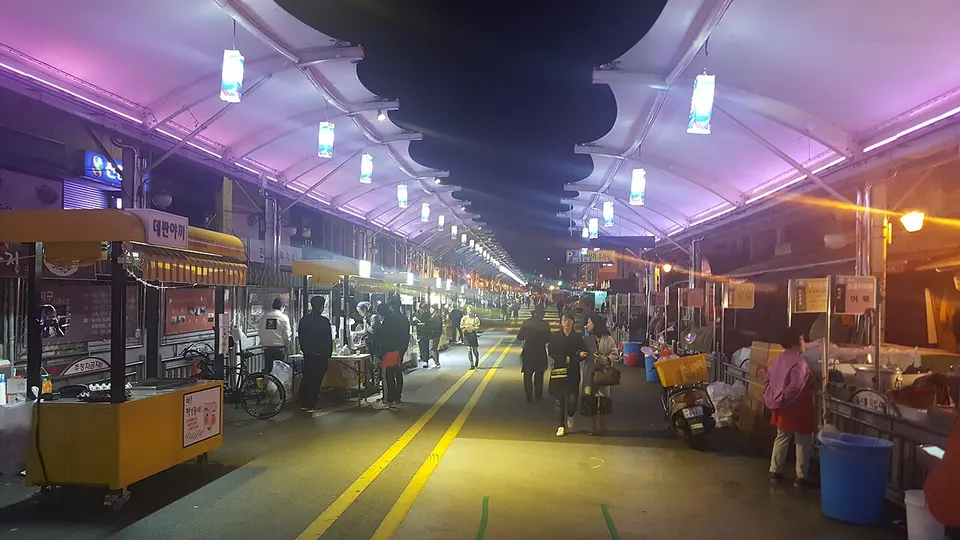
Seomun Market and Night Market
FoodFree (food about ₩3,000–10,000)Day market ≈9:00–18:00 (closed 1st and 3rd Sundays); night market Fri–Sat 19:00–23:30, Sun 19:00–22:30 (sometimes weeknights in summer)
Daegu's largest traditional market — fabrics, clothes and kitchenware. Try the flat dumplings (napjak mandu), kalguksu noodles and hotteok pancakes. In the evening the 350 m night market brings street food and lights; children love it.
Like a well-travelled friend for a first-timer: before you go, landing, SIM, transport, money, food, safety, manners, apps, leaving — step by step.
🧳Before you goVisa, the online arrival card and insurance — sort all three in Ulaanbaatar. The direct flight to Daegu only runs in some summers, so compare the Busan and Incheon options too.+
1
Visa: C-3-9 tourist visa (KVAC)
Mongolian citizens need a visa for South Korea. Apply for a C-3-9 tourist visa at the Korea Visa Application Center (KVAC) in Ulaanbaatar: a single-entry visa valid for 3 months, stay up to 90 days. The visa fee is waived for ordinary passport holders; you pay only the centre's 57,000₮ service fee. Proof of funds such as bank statements is required.
Tip: Get the visa first, then buy the ticket, and nothing is at risk. K-ETA is for visa-exempt nationalities — Mongolian citizens don't need it.
From 2026 Korea no longer uses paper arrival cards: within 3 days before your flight, enter your passport, flight and hotel at e-arrivalcard.go.kr. It is free — beware of look-alike sites that charge a fee.
In summer (July–August) Daegu is Korea's hottest city, so with children pick spring (April–May) or autumn (October–November). Stay around Dongseongno or Jungangno and the metro, markets and history alleys are all walkable; the Dongdaegu Station area suits those arriving by train. Hospitals in Korea are expensive, so travel insurance is a must.
🛬Landing and getting into townDaegu airport is inside the city; via Busan or Incheon the KTX is fastest.+
1
From Daegu airport
The airport is on the east side of the city: ~15 min by taxi to Dongdaegu Station, ~25 min to Dongseongno. City bus 401 runs via Dongdaegu Station and the centre; Ayanggyo station on metro Line 1 is close by.
Tip: If an overnight flight lands early in the morning, ask your hotel in advance whether you can drop your luggage.
A direct bus runs from Gimhae Airport to Dongdaegu in ~1 h 10 min. Or take the KTX from Busan Station to Dongdaegu in ~40 min — trains run many times a day.
Take AREX to Seoul Station, then the KTX to Dongdaegu in 1 h 35–50 min, standard class ~₩38,000. A direct bus from Incheon to Dongdaegu takes ~4 h — cheaper but slow.
If your phone supports eSIM, install an Airalo or KT/SKT tourist eSIM before the flight — it works the moment you land. A SIM counter at Daegu's small airport can't be relied on.
Tip: Install Naver Map in Ulaanbaatar and switch it to English before you go.
The arrivals halls at Incheon and Gimhae have KT, SKT and LG U+ counters: show your passport and get a tourist SIM or eSIM. Phone shops in town sell them too, but with paperwork and a language barrier.
🚇Getting aroundThree metro lines (Line 3 is an elevated monorail) plus buses reach all the main sights.+
1
Metro and T-money
The metro has one flat fare: ₩1,500 with a T-money card. Buy and top up the card at convenience stores (GS25, CU, 7-Eleven); it also works on buses with transfer discounts. Seomun Market, Dongseongno, Apsan and Suseong Lake are all reachable by metro.
Tip: Children love the view over the city from the Line 3 monorail — there is a stop at Seomun Market.
Buses run from the centre and Dongdaegu Station to Palgongsan (cable car, Donghwasa) and Gatbawi — look up routes in Naver Map or KakaoMap. For Haeinsa, take the intercity bus from Seobu bus terminal, ~1 h 40 min.
Taxis are cheap and plentiful; hail one with Kakao T and you don't need to write the address in Korean. For a family heading to outlying places like Spa Valley or Palgongsan, faster than the bus.
💳Money and taxes+
1
Cards and cash
Visa and Mastercard work in most shops, restaurants and taxis. Cash is safer at the small stalls of Seomun Market and the night market. Withdraw from bank or convenience-store ATMs marked 'Global ATM'; there are exchange offices around Dongseongno.
Spend over ₩15,000 in one purchase at a 'Tax Free' shop and you can reclaim VAT. For purchases up to ₩1,000,000 the shop deducts it on the spot when you show your passport (up to ₩5,000,000 per trip); the rest is refunded at the airport.
🍜FoodDaegu is a city of offal and spicy food — whole streets are named after a single dish.+
1
What to eat
Makchang — grilled beef or pork intestines (Daegu's signature dish); the spicy braised short ribs of the Dongin-dong jjimgalbi alley; the Anjirang gopchang alley; flat dumplings (napjak mandu) and kalguksu at Seomun Market. Daegu is also the birthplace of 'chimaek' — fried chicken with beer.
Tip: No tipping in restaurants; side dishes (banchan) are free and refilled on request. Ask for jjimgalbi '덜 맵게' (less spicy).
2
With children
Fried chicken, gimbap, hotteok and tteokbokki at Seomun night market and on Dongseongno. Gimbap, ramyeon and ready meals at GS25 and CU are cheap and reliable; there are plenty of family restaurants around E-World and Suseong Lake.
🛡️Safety and health+
1
Emergency numbers
Police 112, ambulance and fire 119 — free, 24 hours. The 1330 Korea Travel Helpline answers in English 24 hours a day and can connect you to the police or ambulance with three-way interpreting.
Daegu's average August high is 31°C, some days pass 35°C and the record is 40°C. Carry water and a hat, spend midday in the metro, museums and malls, and follow the official heat and typhoon alerts that come to your phone.
Kyungpook National University Hospital and Keimyung University Dongsan Medical Center have emergency departments and international patient centres. For minor ailments a pharmacy (약국) is enough. Call your insurer's assistance line first.
At Donghwasa, Gatbawi and Haeinsa keep quiet and don't photograph in front of people praying. Take your shoes off before entering worship halls. Photography is banned inside Haeinsa's Tripitaka depositories.
2
On the metro and at markets
The pink metro seats are for pregnant women and the end seats for the elderly — don't sit in them even when empty. Ask before handling goods at a market stall; haggling is not the norm.
3
At the table
Wait for the eldest to pick up their spoon before eating; never stand chopsticks upright in rice. Pour drinks for elders with both hands.
📱Useful apps+
1
Maps
Google Maps gives almost no walking or driving directions in Korea — use Naver Map or KakaoMap. They show Daegu's metro and bus routes with real-time timetables.
Flying home direct from Daegu, the airport is 15–25 min by taxi from town. Via Busan, take the KTX from Dongdaegu or the direct bus to Gimhae; via Incheon allow over 3 hours for the KTX plus AREX. Plan to be at the airport 2–3 hours before an international flight.
VAT not deducted in the shop is refunded at the airport's TAX REFUND kiosks — carry the receipts and the goods together. The T-money balance can be refunded in cash at a convenience store.
AI answer: double-check anything beyond our researched facts with an official source.
A 350 m mural street honouring the beloved singer Kim Gwang-seok, who grew up in Daegu: a statue, buskers and small cafés. Daegu's best-known photo spot, right next to Bangcheon Market.
KidsFull-day pass ₩49,000 (youth ₩44,000, children ₩39,000; online discounts); 83 Tower observatory ₩15,000 (children ₩12,000)Park ≈10:00–21:00 (varies by day, longer at weekends); 83 Tower 11:00–20:30
A theme park in the middle of the city and the 83-storey tower that is Daegu's landmark. Pretty with spring blossom, autumn leaves and evening lights; the whole city is visible from the top of the tower. The family favourite.
Palgongsan: cable car, Donghwasa Temple, Gatbawi Buddha
NatureCable car return ₩13,000 (children ₩7,000); Donghwasa and Gatbawi freeCable car ≈9:30–18:00 (varies by month); temples morning to evening
Palgongsan National Park (since 2023) north of the city: the cable car climbs to 820 m with views over the city. Nearby Donghwasa Temple has a 33 m stone Buddha. On the other side of the mountain the Gatbawi Buddha, with a flat 'hat' of stone, is said to grant one wish; about an hour of steep stairs up. Spectacular in autumn.
NaturePark free; cable car return ₩14,000 (children ₩10,000)Cable car from 10:30; last ride down around sunset on weekdays, 2 hours after sunset Fri–Sun and holidays
The mountain on the south side of the city: ride the cable car up and watch Daegu's lights from Apsan Observatory — the city's most famous night view. Walking trails and the 'Apsan café street' at the bottom.
CultureMuseum freeMuseum 9:00–18:00 (closed Mondays, 1 January, Seollal and Chuseok)
Korea's oldest herbal medicine market, running since 1658: the streets smell of ginseng, roots and dried herbs. The museum explains traditional medicine and lets children try mixing a remedy.
Modern History Alley (Cheongna Hill, Gyesan Cathedral)
CultureFree (free English-guided walks by Jung-gu district, book ahead)Alley 24 hours; Gyesan Cathedral ≈9:00–18:00 (quiet during Mass)
Early-20th-century Daegu: the red-brick missionary houses on Cheongna Hill, the 90 steps of the 1919 March 1st Movement, the Gothic Gyesan Catholic Cathedral of 1902 and poet Lee Sang-hwa's house. Links up with Yangnyeongsi and Seomun Market on one walk.
Daegu's 'Myeongdong': a pedestrian zone of cosmetics, fashion, cafés, karaoke and an underground mall. Lively with young people and buskers in the evening; Daegu Department Store and Hyundai Department Store are nearby.
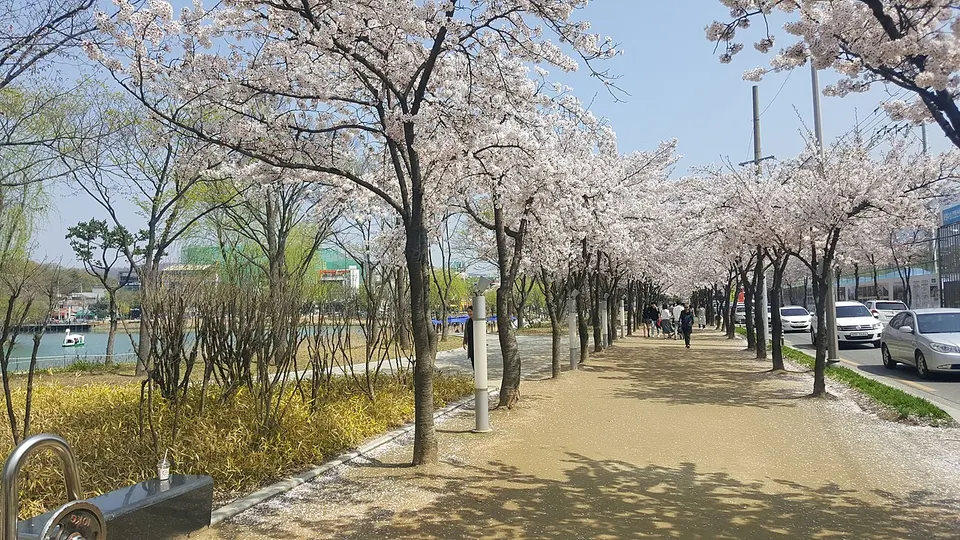
A city lake with a 2 km walking path, swan boats, cafés and restaurants. Fountain shows and lights in the evening, cherry blossom in spring. Where locals go for an evening stroll — relaxed for families.
Culture₩1,000 (free on Wednesdays)April–October 10:00–19:00, November–March 10:00–18:00 (closed Mondays)
A large contemporary art museum with Korean and international exhibitions and a children's art room. A good choice for a hot or rainy day; Daegu Grand Park is nearby.
KidsAdults ₩38,000–52,000, children ₩30,000–40,000 depending on season (discount for foreigners)≈9:00–18:00 (varies by season; closed on some days)
A water park on the southern edge of the city filled with hot-spring water: outdoor pools, a wave pool and slides in summer, warm spa pools in winter. The family escape from Daegu's summer heat.
Haeinsa Temple and the Tripitaka Koreana (day trip)
CultureFree (since 2023); museum about ₩2,000≈8:30–18:00 (varies by season)
One of Korea's Three Jewel Temples, in the forests of Mt Gayasan: the more than 80,000 wooden printing blocks of the Tripitaka Koreana and their depositories are UNESCO-listed. ~1 h 40 min by bus from Daegu's Seobu bus terminal; loveliest in autumn colours.